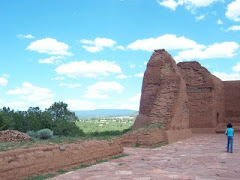
That is Polish immigrant Martin Kozlowski near the trading post he located in a prime spot, near Glorieta Creek and the Santa Fe trail. Today we visited the trading post and saw where Union soldiers encamped nearby before the battle of Glorieta Pass.

There is considerably more snow in Pecos still (March 2010) than there is in Santa Fe.
On March 26, 1862, Confederate and Union soldiers stopped at each end of Glorieta pass - the Confederates at Apache Canyon to the west and the Federals at Pigeon’s Ranch to the east.
The two forces then briefly clashed near the Confederate base at Apache Canyon

before retiring to their respective camps.
Hostilities resumed the morning of March 28th, as both sides advanced into Glorieta Pass. The Confederates chose to send most of their forces into the attack, and left perhaps 30 or 40 troops to guard the supply train in the rear of Apache Canyon at Johnson’s Ranch. Four hundred Colorado Volunteers descended from the steep mountains late in the day and surprised the far outnumbered Confederate rear guard at Johnson‘s Ranch.


Even though the rebels had an advantage in numbers and they pushed the Federals back toward the eastern edge of the pass, at one point shelling the Federal camp at Pigeon’s Ranch,

This is what's left of Pigeon's Ranch today...a building that was a station stop along the Santa Fe trail...it's only about four feet from the road.
they still had to retreat because of what the Union had done to their supply wagons. They were, after all, in New Mexico, and whatever they needed they had to have with them--especially water and food, but also saddles, medicines, ammunition. Without their supplies, the Confederates had no choice but to retire from the field and withdraw to Santa Fe. Soon they pulled out of New Mexico territory for good.
The Confederate leaders thought they could manage to live off the land and they thought westerners would rally to their cause. They were wrong on both counts.
Here is the granite monument to the Texas Volunteers

commemorating the Texans who fought and perished as part of the Sibley Brigade during the "farthest penetration of Texans along the Santa Fe trail."

This is the rose red granite monument to the 1st Colorado Volunteers, who "saved the Union in Northern New Mexico." The monument was dedicated on March 27, 1993.


 It is believed that they originally served as kin group meeting places or even dwelling units and then later became religious centers. Many were aligned with entrances and vent shafts running due north and south.
 The sipapu represents the emergence place, the walls the sky, and the roof the Milky Way (Malville 8). In fact some kivas belonging to the Pueblo Indians had complex wall paintings displaying astronomical symbols (Williamson 190) [we have not seen this in our kiva travels]. The roof of the kiva was typically supported by four posts, which according to Malville, could have represented the four cardinal directions, "the four trees planted in the underworld or the four sacred mountains" (8). Even the ladder used to climb into and out of the kiva could be considered a symbol of the emergence with the ritualization of emergence being performed whenever someone climbed out of the kiva (Williamson 71)."


 We recommend it, and we'd say that even if we didn't know Doug. We were invited to this Independence Day party by friends


 men's and children's ceremonial dress, baby carriers, quilt covers, festive and religious vestments, silver jewelry, embroidered silk valences, and wax-resist dyed curtains, plus a loom, weaving tools, and embroidery cases. The more than 500 objects in this exhibit represent 15 ethnic groups and nearly 100 subgroups in China. The needlework and silverwork of each ethnic group show variations in their myths of origin and heroic combats, communal memories, and wish fulfillment.